Cursor Jupyter Notebook MCP Server

Created By
jbenoa year ago
This is a Model Context Protocol (MCP) server designed to allow AI agents within Cursor to interact with Jupyter Notebook (.ipynb) files. It uses the nbformat library to safely manipulate notebook structures and enforces security by restricting operations to user-defined directories. It also uses nbconvert to enable exporting notebooks to various formats like Python scripts, HTML, and more. The server handles all notebook operations through a clean API that maintains notebook integrity and prevents malformed changes.
Overview

Jupyter Notebook MCP Server (for Cursor)

This directory contains a Model Context Protocol (MCP) server designed to allow AI agents within Cursor to interact with Jupyter Notebook (.ipynb) files. It was created to overcome a limitation with Cursor. As of version 0.48.9, in Agent mode, the model could not edit notebooks or notebook cells in response to dialog in the AI chat pane. This provides the agent with a suite of MCP tools that allow direct notebook cell manipulation.

I'm sure at some point this will be handled natively by Cursor, but I have a data science background, and I live in Jupyter notebooks. I got tired of copy/paste-ing output of the chat manually into the notebook cells.

Although designed to overcome a limitation with Cursor, this MCP server does not have anything specific to Cursor other than the configuration instructions. You could easily configure this for use with Claude Code or any model/agent that can take advantage of MCP.

This MCP server uses the nbformat library to safely manipulate notebook structures and enforces security by restricting operations to user-defined directories. It also uses nbconvert to enable exporting notebooks to various formats like Python scripts, HTML, and more. The server handles all notebook operations through a clean API that maintains notebook integrity and prevents malformed changes.

Video Walkthrough
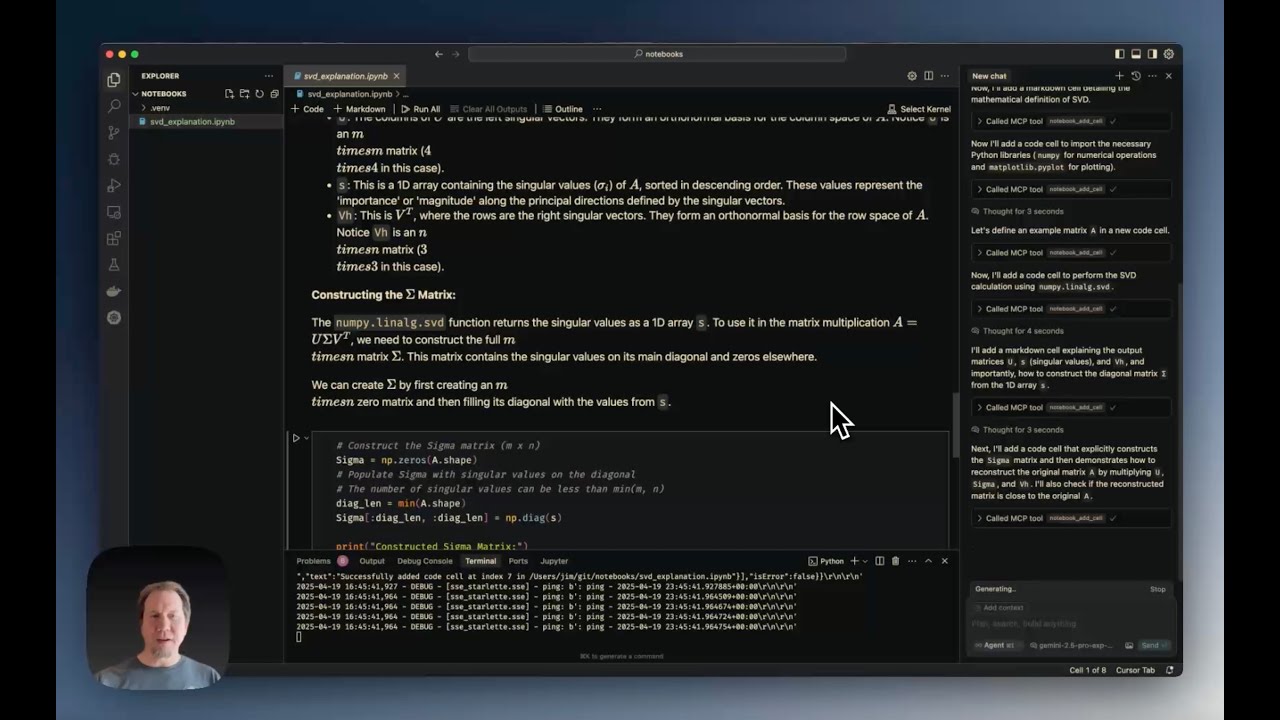
Video Walkthrough Thumbnail

Cursor Jupyter Notebook MCP Server (YouTube) walks through:

  • The current limitations of editing notebooks directly in Cursor.
  • Installing and configuring the Notebook MCP Server.
  • Creating a notebook from scratch (example shown: Singular Value Decomposition tutorial in less than 2 minutes).
  • Demonstrating various editing tools (edit, split, duplicate cells).
  • Reading notebook metadata.
  • Exporting notebooks to python
Project Info
Created At
a year ago
Updated At
a year ago
Author Name
jbeno
Star
-
Language
-
License
-
Category

Recommend Servers

View All
Voyei

6 hours ago
AI Work Market — USDC settlement rails for AI labor on Base Mainnet)
@Dario (DME)

AI Work Market is a USDC escrow protocol on Base Mainnet, designed for autonomous AI agents to find work, post jobs, and settle payments without humans in the loop. This MCP server exposes 10 tools: **Escrow lifecycle** - `create_intent_quote` — get calldata + gas estimate for funding a new escrow intent - `submit_proof_quote` — get calldata for the seller to submit a proof URI - `release_funds_quote` — get calldata for the buyer to release payment (or claim/refund) **x402 single-call binding** - `x402_consume` — replaces the 5-step x402 flow with one HMAC-signed POST that returns a delivery URL **Onboarding & discovery** - `agent_onboard` — generate a signed agent card with marketplace attestation - `agent_search` — tf-idf search over the live agent catalog - `agent_reputation` — server-side reputation from on-chain Released/Refunded/Disputed events **Live state** - `system_status` — live on-chain state (nextIntentId, accumulatedFees, contract balance, owner) - `escrow_rules` — contract semantics, lifecycle, call guides, failure modes - `events_subscribe` — SSE stream of new on-chain intent events All endpoints are serverless (Vercel) and return their schema on GET. No browser, no wallet UI required for an agent to integrate. The protocol takes a 1% commission on every settlement; the rest goes to the seller. The full AgentCard is at `/.well-known/agent-card.json` (A2A-compatible). The OpenAPI 3.0.3 spec is at `/.well-known/openapi.json` with `components.securitySchemes` (none, hmacX402). `robots.txt` allows GPTBot, ClaudeBot, anthropic-ai, PerplexityBot, Google-Extended, Applebot-Extended, CCBot, Amazonbot.

16 hours ago